


Why refrigerant choice matters — and what it means for cold chain in underserved communities
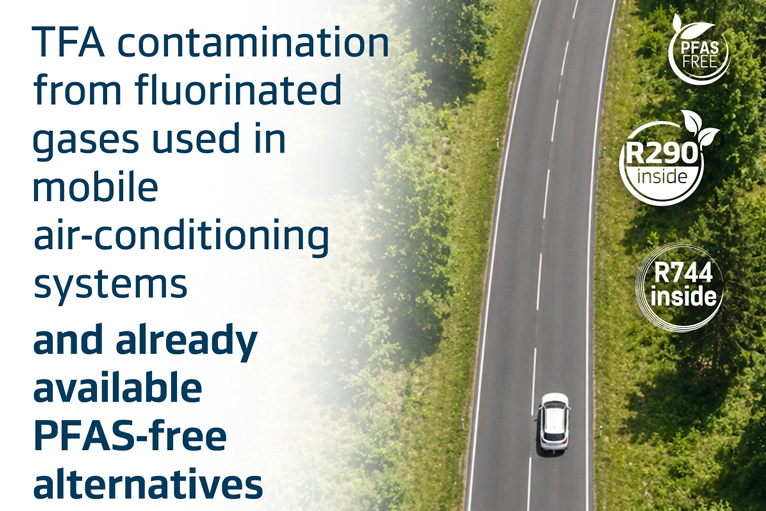
A May 2026 white paper by Hanon Systems (a Hankook Company) sheds new light on a growing environmental and public health concern: the refrigerant R1234yf, now standard in vehicle air conditioning across Europe, degrades almost completely into trifluoroacetic acid (TFA) — a persistent PFAS “forever chemical” — within just ten days of atmospheric release.
TFA is already measurable in rainwater, tree needles, wine, cereals, and human blood. Concentrations in Swiss precipitation doubled between 2018 and 2025. Without regulatory action, cumulative TFA emissions from Europe’s passenger car fleet alone could reach 240,000 tonnes over the next 30 years — 3.6 times more than the previous 50 years combined.
What does this have to do with cold chain for health?
Everything. TFA accumulates in the water cycle — in rivers, groundwater, and drinking water sources. Communities with already limited access to safe water and healthcare are the most exposed to the downstream consequences of environmental PFAS contamination. This is precisely the context in which SophiA operates: pharmacies and hospitals in underserved regions where resilient, clean infrastructure is not a luxury but a necessity.
The Hanon white paper also carries an encouraging message: PFAS-free alternatives exist and are proven. Natural refrigerants R744 (CO₂) and R290 (propane) are technically ready. Over one million vehicles already operate with R744 heat pump systems — with no PFAS, no TFA, and a global warming potential of just 1.
At SophiA, we design cold-chain solutions with exactly this logic: choosing refrigerants and technologies that are safe for people, safe for water, and safe for the long term. Because in the communities we serve, what goes into the environment comes back — in the water, in the food, in the body.
📄 Download the full white paper to read more: Hanon-Systems-PFAS-free-MAC-White-Paper-May-2026.pdf